

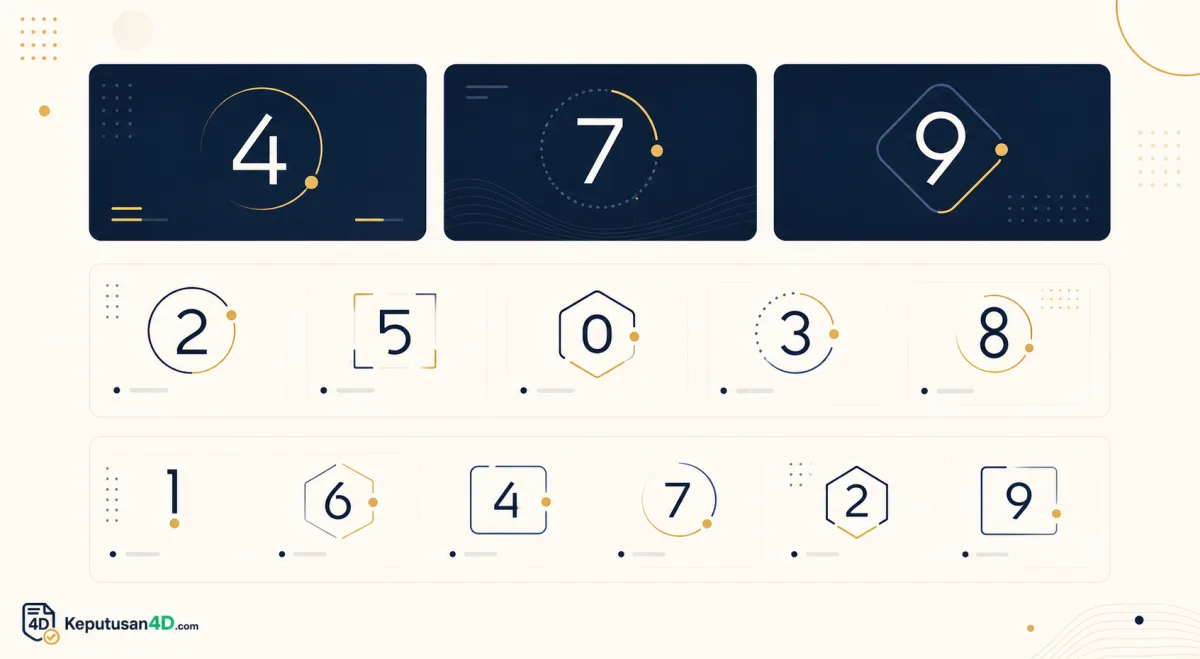
A published 4D board is organised into clearly labelled sections. Reading them in order helps you locate each published entry and understand how the board is laid out. This guide describes the layout of a published board only — what each section is called and how many numbers it holds — so you can read any operator the same way.
How a published board is organised
Every 4D board is divided into labelled sections shown in a fixed order: the top three positions first, then the Special section, then the Consolation section. Once you recognise the sections, you can read any operator's published result the same way, because the structure does not change from operator to operator — only the digits do.
The full board at twenty-three positions
Put together, a complete board holds twenty-three published positions: three at the top, ten in Special and ten in Consolation. The table below maps every position so you can see the whole layout in one view. The digits are dummy placeholders for illustration; they are not a real result.
| 1st Prize | 1234 | |||||||||
|---|---|---|---|---|---|---|---|---|---|---|
| 2nd Prize | 5678 | |||||||||
| 3rd Prize | 9012 | |||||||||
| Special (10) | 3456 | 7890 | 2345 | 6789 | 0123 | 4567 | 8901 | 2468 | 1357 | 9753 |
| Consolation (10) | 8642 | 1470 | 2580 | 3690 | 4812 | 5927 | 6033 | 7148 | 8259 | 9360 |
The top three positions
The first three positions are shown at the top of the board, labelled 1st, 2nd and 3rd. These are the three numbers an operator lists first in its published result, and they are usually the most prominent part of any board.
The Special section
Below the top three, the Special section lists ten further numbers published for that draw. On most boards these are shown together in their own labelled block of ten, directly under the top three.
The Consolation section
The Consolation section lists ten more numbers, completing the published board. Together with the top three and the Special section, this brings the published result to twenty-three numbers in total — the full set you see on a Final board.
Why the sections are in this order
Reading the board from top to bottom mirrors the way operators present their results: the headline positions first, then the larger Special and Consolation blocks beneath them. This fixed order is what lets you scan quickly. If you only want the headline positions, you stop after the top three; if you want the complete published result, you read on through Special and Consolation to the twenty-third number. Because the order never changes, you always know where a section will be before you even open a board — the top three are always at the top, Special always follows, and Consolation always closes the board.
Counting the positions
It is worth being precise about the count, because "twenty-three" is the number you will see referenced across the site. Three positions sit at the top (1st, 2nd, 3rd). The Special section adds ten. The Consolation section adds another ten. Three plus ten plus ten makes twenty-three published positions on a complete board. When a board shows fewer than twenty-three, it is usually still publishing — a sign to check the status and wait for Final rather than assume the board is short.
The same board across different operators
Although each operator runs its own draw, the published board reads the same way everywhere we display it: top three, then ten Special, then ten Consolation. A daily operator such as 9 Lotto and a Wednesday/Saturday/Sunday pool such as Sports Toto present the same twenty-three-position layout, so once you have read one board you can read them all. A few operators publish extra formats next to their 4D board — Da Ma Cai and the East Malaysian operators run 1+3D and 3D draws, for instance — but those appear as separate blocks, and the 4D section itself always follows the same twenty-three-position structure. That consistency is the whole point of reading results in one place: the layout you learn here applies to every operator in our operators directory.
Sections versus the Big and Small labels
It is worth keeping two ideas separate. The sections — top three, Special, Consolation — are the actual parts of the board, each holding its own numbers. The Big and Small labels, which you will also see on many boards, are not extra sections; they are just two views that bundle these same sections together. Big shows all three sections at once (twenty-three numbers), while Small shows only the top-three section. So when you read about Big and Small, you are reading about how the sections on this page are grouped for display, not about any additional part of the board.
Reading the sections together
When you open a result on the homepage or an operator page, you will see these sections laid out in this order. If you also want to understand the Big and Small labels some boards use to group these sections, see our Big and Small guide; to walk through reading a board step by step, see how to check 4D results.
FAQ
How many numbers are in a 4D result?
A published 4D board has twenty-three numbers in total: the top three positions, ten in the Special section and ten in the Consolation section.
Why 23 numbers?
The board is built from three named sections — three top positions, then ten Special and ten Consolation — which add up to twenty-three published positions. The same structure is used across the operators we display.
Which section should I check?
That depends on what you are reading for. The top three sit at the top of the board; the Special and Consolation sections follow below. All three sections together make up the full published result.
What does the Special section show?
The Special section lists ten numbers published for that draw, shown in their own labelled block below the top three positions.
What does Consolation mean on a 4D board?
Consolation is the labelled section listing ten more numbers that completes the published board, bringing the total to twenty-three.